Day 7 Monday, November 18, 2019 Shanghai
Our visual highlight of China was Shanghai's skyline at night, seen from our river cruise. Behind us is a city icon, the Pearl Eye telecommunications tower. That entire area is the financial area, called the Pudong District. It was a full day of city touring, although twice, for three hours total, we were just let go for "shopping". But capping it off with this river cruise was wonderful.
This is the view out our window when we awoke. We knew that UTO used less-expensive hotels located in the city outskirts, but this was a pretty bad spot. Completely run down out there. No wonder there were no restaurants nearby. See all the tour buses down there? This hotel was far to the southeast of the downtown area, not too far from the Pudong Airport where we flew into and would fly out of the next day.
Another view out our window, just down the street. The "other side" of China from what we'd been seeing - the less fortunate.
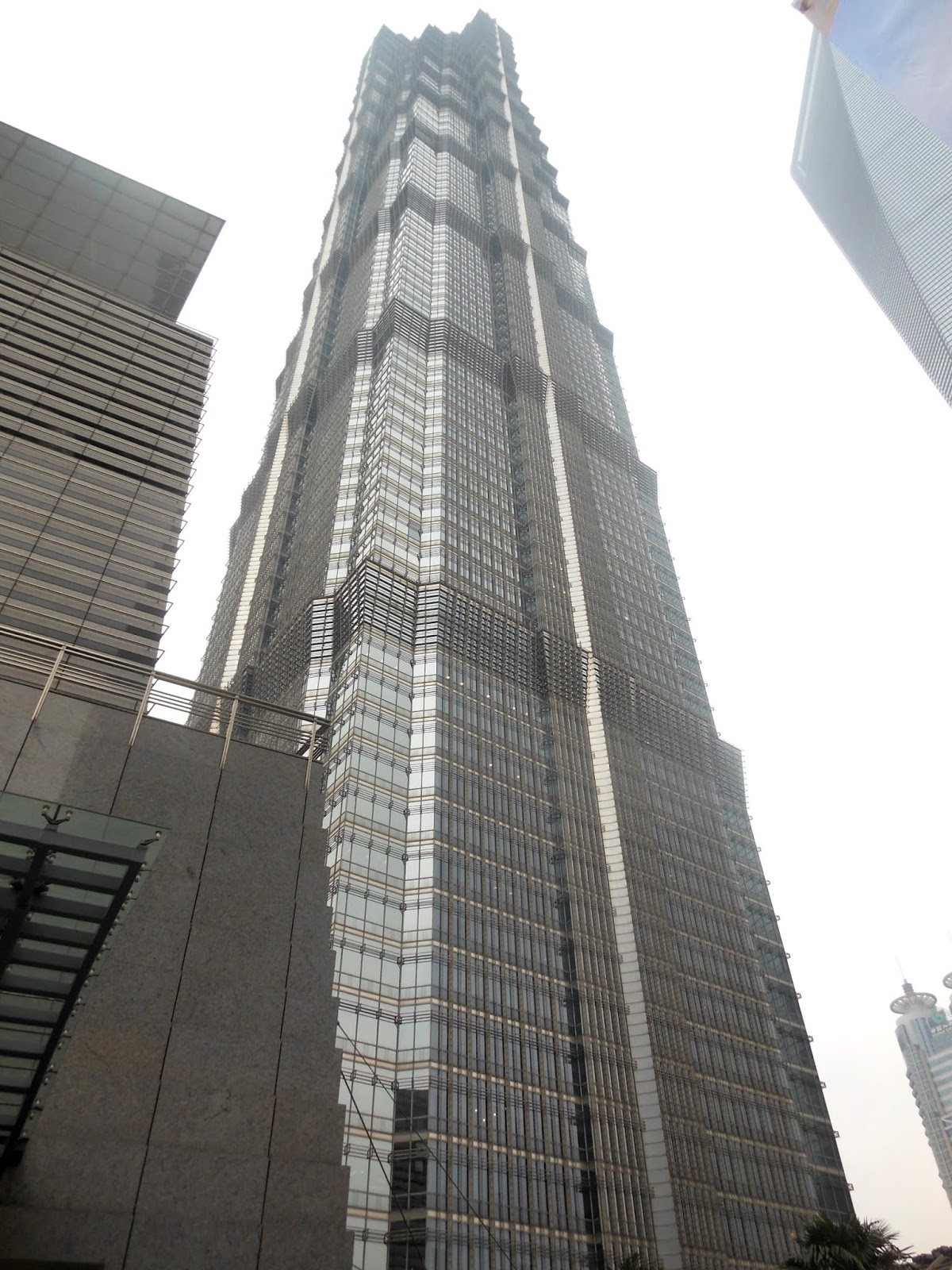
Our buffet breakfast was the usual - lots of interesting choices, some of which we avoided at all costs. Then we boarded our bus for the day tour, which was optional, and most of us took it. We began by driving 45 minutes into the city to visit the Jin Mao Tower, an 88-story landmark skyscraper in the financial district (east side of the river).
The Jin Mao Tower is 421 meters tall (1380 feet) (Empire State Building is 1454 ft). It contains a shopping mall, offices and the Grand Hyatt Hotel (at the time of completion it was the highest hotel in the world). It was the tallest building in China from its completion in 1999 until 2007, when it was surpassed by the nearby World Financial Center. The Shanghai Tower, a 128-story building located next to these two, surpassed the height of both in 2015,
creating the world's first trio of adjacent supertall skyscrapers.
A highlight of visiting the tower was getting to watch these cute school children. Just as we were given time to use the restrooms before ascending up the elevator, these children also were using the same restrooms. They were just so charged and happy, and their teachers were herding them to and fro, and into these lines. Later, in the tower observation areas, they were just having so much fun.
Janet's comment: Waiting in a long
line to use the restroom, I said hello to a couple of these adorables!
They quickly responded back on cue, “Good morning.” Thought I would move
forward with their knowledge of the English language and said, “How
are you?” Melted my heart to hear them
recite in unison, “ I am fine, thank you!” They loved being able to
respond and sang a song for me, showing me words for ears, mouth, eyes
and nose. I also got a chance to visit with their teacher. How I loved
her joyous teacher-passion for these children. So many similarities in
connecting to others that live so far away and in different living
conditions. Heart to heart, isn’t that what life is for?

It was a hazy morning, so the views were limited in distance. You see again the Pearl Eye communications tower, also shown in the top photo in this posting. The river is the Huangpu River, which flows a few miles north to empty into the famous Yangtze River just as it reaches the ocean. The top end of the Bund is on the far side of the river.

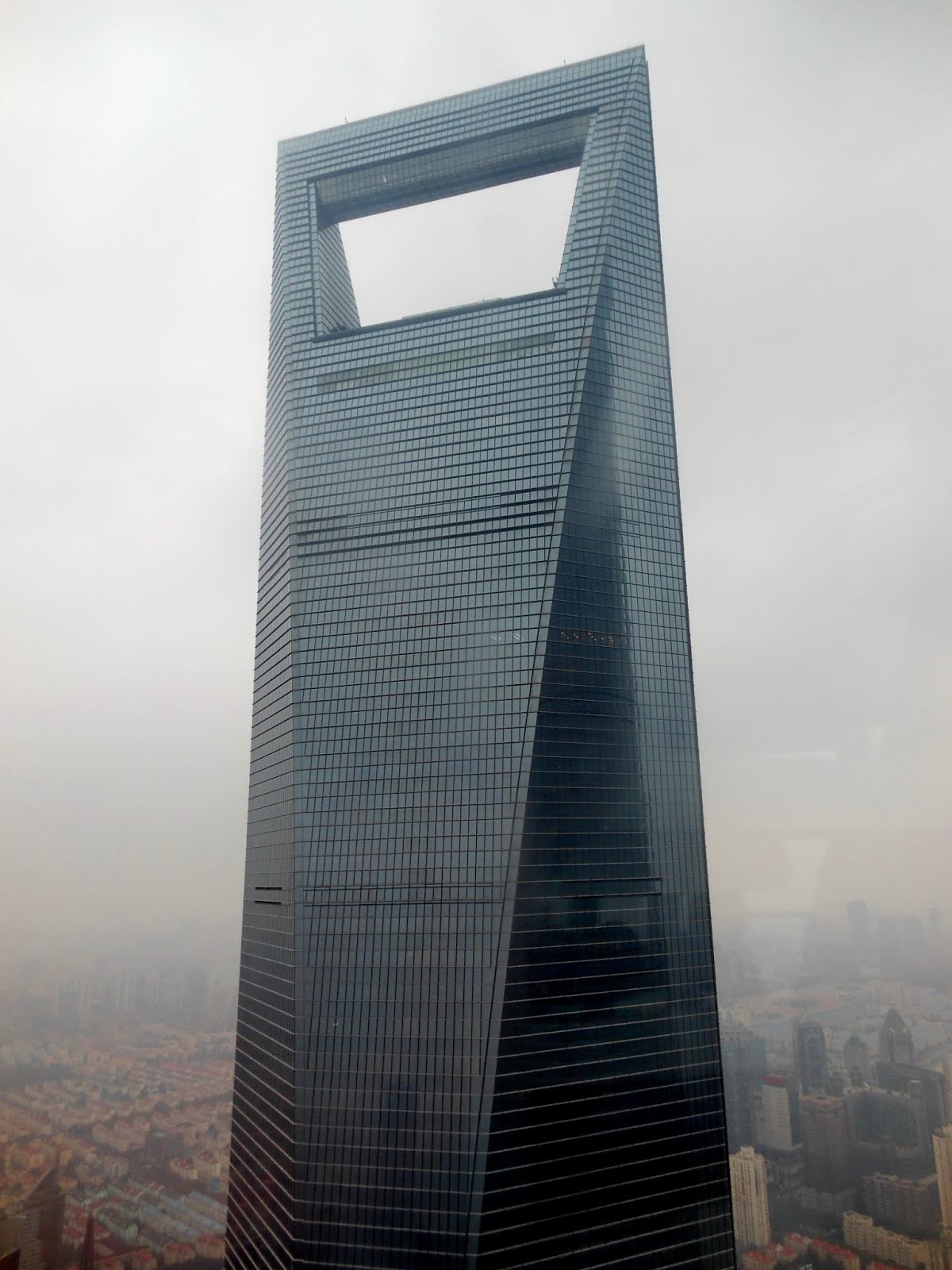
This map shows where we visited on this day. In the center, where the river bends, are the Pearl Eye Tower, and just to its right, the Jin Mao Tower. I have photos below of the skyscraper next to it, with the "window" near the top of its 118 stories, the World Finance Center. Across on the west side of the river is the Bund and the old city. A little to the south of the old city are two of the shopping areas we visited later in the so-called French Concession. We then bused way off this map, to the east and south, to the airport, and took the Maglev train back to the bottom right corner on the map (see where it says Maglev Train?). We then went a short distance up near the green Century Park to the Knock Off Market. Finally, our night cruise boarded just above the Pearl Eye Tower and went south, and then we turned around and returned.
This view from the Jin Mao Tower shows the bottom end of the Bund and the old city.
The Shanghai World Finance Center next to us, 234 feet higher than where we were.
The other nearby skyscraper was the Shanghai Tower, the tallest of the three at 128 stories, and 693 feet higher than where we were. I thought it was interesting that the entire outside of the building was glass, and you could see right through its sides.
Here's a picture in the observation room with all those kidlings being rounded up by their teachers.
There was a wall display about the Spaniard who set the record for climbing the 2008 steps of the tower (in the year 2008!) on his mountain bike. Took him 39 minutes, 38 seconds.
The display also showed the record progression, starting 2006, when it took 1 hour 41 minutes. Wow, the big drop in time happened when the Chinese guy did it in 48 minutes, from the previous record of 93 minutes. I'm sure I could not jump even a single step on my bike.
This is a strange photo, but it's looking down from the center of the observation floor, into the Grand Hyatt Hotel below. The 548-room hotel occupies the 53rd to 87th floor, so the landing at the bottom is the 53rd floor.
From the skyscrapers on the eastern financial side of the river, we crossed over to the old city and went a bit south to an area called Tianzifang, a touristic arts and crafts enclave that has developed from a renovated
traditional residential area in the French Concession. It's now home to over 200 boutique shops, bars and restaurants. Look at all those overhead wires; it reminded us of Bangkok.
We are not really shoppers, but it was interesting walking around this area because we were looking to buy "stocks" for each grandchild. (Jeanette and Mike had gotten some previously, and after seeing them, we thought they would be special gifts. They are marble stamps with the child's name in both English and Chinese, including their zodiac animal.)
In 1849, the French were given this area as a gesture for trade relations.They were like little foreign enclaves within the city. Chinese were originally forbidden from entering, but they later were allowed in. It remained under French control clear up until 1943.
So many cute little joints, like this one with a wine cask on each table!
With only about 25 minutes to go in our hour to roam, we found this little vendor who sold stocks. You can see they are little square columns, and the zodiac animal is carved into the side of them. On one end is where she will carve/etch the names. We negotiated a price for six of them, and the process began!
We told her the birth years for Morgan, Rylee, Tyson,
Liam, Lexie, and great-niece Sophia. We slowly pronounced each name as
she wrote down the Chinese characters that would sound like those names. This photo shows her getting ready for the carving by writing the characters for each name. I made this photo large so you can see "Monkey Lexie", then "Rabbit Tyson and Sophia", then "Pig Morgan" and Dog Rylee." The top name for "Horse Liam" is hard to see at the top of her listing.
She set about carving the ends of the marble stamps. Of course, she had to carve them in a mirror image so that when stamped onto something, the letters would read correctly.
You can see one of the stocks in her right hand, and all the others on her top shelf. The white powder is the marble shavings from the carvings, and she's getting ready to throw it into the trash. The stocks came out great!
In this picture, she is applying some red ink to her finished carving to test it on a small piece of paper. They came out perfectly. When we got home, we bought six red ink pads and gave the kids their souvenir stocks for Christmas. They were a big hit!
By the time we paid and got back to the meeting place, we were a few minutes past our allowed hour, but others were even later so it was not a problem. We then drove less than a mile farther south to another renovated enclave from the French Concession called Xintiandi. This area had been completely torn down and rebuilt to be a trendy restaurant area. We were let loose in this square to find lunch. Janet and I found a nice Italian place and enjoyed our novel pizza and other unique dishes.
Shanghai was originally a fishing village and market town, but grew in the 19th century due to its perfect protection up the river from the ocean. It became one of five "treaty ports" forced open to foreign trade after the First Opium War. In 1949 under the new People's Republic of China's Chairman Mao, trade was limited to other socialist countries, and the city's global influence declined.
But in the 1990s, economic reforms resulted in an intense redevelopment of the city, especially the Pudong financial district, aiding the return of foreign investment to the
city. The city has since re-emerged as a hub for international trade and
finance; Shanghai has been described as the showpiece of the booming Chinese economy.

After lunch, when we got back late and Steve had to call me to ask where we were (oops), we took the long bus ride out to the airport. There, we went to the adjacent train station to ride the world's fastest passenger train, the Maglev (which stands for Magnetic Levitation).
There's the train, with Sumi posing. The line is the third commercially operated maglev line, following a British and a German one, but both were low-speed operations and closed before the opening of the Shanghai train. This is the fastest electric train in the world with a cruising speed of 431 km/h (267 mph).
It wasn't too crowded at 3 pm on a Monday. We're getting ready to take off. This train run is very short, actually, traveling only 19 miles into the city. By the time it reaches full speed, it has only about a minute before it must start slowing down.
The monitor over head was fun to watch. We departed exactly at 15:00 (3 pm), so in one second it had gotten up to 9 km/h. Not yet impressive, but wait!
64 mph in 32 seconds...
141 mph in 85 seconds...
261 mph in less than 3 minutes. It reached its top speed of 267 mph (431 km/h) six seconds later, but my photo of the monitor came out blurred. Janet was next to the window and got some photos of the scenery whizzing by, so maybe I can get a few of those and add them later. The speed remained at its max only for a minute or two before it had to start slowing down. Remember, our trip was just 19 miles, and it took only 8 minutes!

Here's the track for the maglev train. The "levitation" it achieves allows for no contact and therefore no friction. From Wikipedia: "It uses two sets of magnets, one set to repel and push the train up off the track, and another set to move the elevated train ahead, taking advantage of the lack of friction ...there are no moving parts. The train
travels along a guideway of magnets which control the train's stability
and speed. Maglev trains are therefore quieter and smoother than
conventional trains, and have the potential for much higher speeds...and can accelerate and decelerate much faster than
conventional trains; the only practical limitation is the safety and
comfort of the passengers."
I have no more photos until our river cruise a few hours later. When we departed the train, we went only a short distance north to the so-called Knock Off Market, and were given two hours "to shop". Sigh... It was actually named A.P. Xinyang Fashion and Gifts Market, and was all indoors, underneath the Science and Technology Museum. It was massive and crowded, with 100s of vendor stalls.
Actually, Janet did bargain and purchase this pretty lantern, seen here hanging in our home. But we saw as much as we cared to in about 40 minutes, and then had to wait the additional 80 minutes until Steve would be back to get us. Many of us felt the same, because we all gathered, talked, and grumbled a bit about this "all-day optional tour" that dumped us here for two hours. Some of us, including me, sat on the floor, and I actually took a little nap.
When Steve finally arrived, we took our bus back across the river and up to our boat dock. Our next optional excursion was what turned out to be a highlight for us in China, at least from a visual standpoint. But getting onto the boat was a "cultural experience" in itself. Steve later tired to explain that the pushing and shoving to get to the front of the line was common among the less-educated Chinese. But wow, it was hard to take, and I actually physically shoved one guy right back to behind me after he had pushed past me. Janet laughs to this day about how shocked everyone was behind us who witnessed that.

We eventually all got onboard, and the boat headed south with a spectacular light show on both sides of the river. On the lower decks where we began, it was extremely crowded. But pretty soon, Steve negotiated with the staff and we got to go to the top deck, which gave us (cold and windy) uncluttered views and photo ops. Behind Janet is again the Pearl Eye, plus the three tall skyscrapers we had seen in the morning from the top of Jin Mao (seen a bit to the left of the Pearl Eye, with a golden pointy top).

On the other bank of the river was the Bund, with these older government buildings plus some new fancy high rises behind. Janet and I (and the five others) had missed visiting the Bund on the first day, but here's a little about it: From the 1860s to the 1930s, this was the main port area when Shanghai was a "treaty port", a rich and powerful foreign establishment (with the French Concession as well as German, English, and USA Concessions). The Bund has dozens of historic buildings along the Bund, including banks, trading houses, consulates, and "clubs", e.g., a Masonic Lodge.
This photo is from when we first departed the dock, taken on the west side of the river, but we had not yet gone far enough to have reached the Bund.
Another shot of the Bund, but from much farther downriver.
Here again we see the three super skyscrapers in the financial district. The Shanghai Tower is the tallest, to its left is the World Financial Center, and partially blocking that is the Jin Mao Tower.
The entire cruise was an amazing display that China created to show off their economy and status in the world, and it worked. This was near the end of the cruise, with the Bund behind me on the left, and north of the Bund on the right.
When it was time to depart the boat, there again was a massive crowd push, only this time, it turned out we were standing right where they opened the gate to exit. Thus, I held onto the rails and used my body to push the hoard back while those of us who just happened to be in that spot could exit calmly without getting stampeded. Hee hee (Even though I'm only 5'8" and skinny, I was bigger than the "locals" doing the pushing.)
On the ride back to our hotel, Steve had the bus wait while several of us went into a McDonald's to buy dinner (rather than eating at the hotel restaurant again). That's what Janet and I ate, and it was kind of a relief to have familiar burgers. At the hotel, we packed for our flights the next morning. What a day, and what a week in China! We did not venture far into that vast country, but we nevertheless experienced much of their culture and history, and many fascinating sights. Yes, their economy is booming, but it remains an authoritarian dictatorship which limits freedoms and cracks down hard on expressions of dissent. "Great to visit, but we wouldn't want to live there" (whereas when we visited places like New Zealand and Australia a year ago...).
On to Japan!