Saturday, January 18, 2020

Touring Shanghai, including a 267-mph train ride

Day 7  Monday, November 18, 2019   Shanghai

Our visual highlight of China was Shanghai's skyline at night, seen from our river cruise. Behind us is a city icon, the Pearl Eye telecommunications tower. That entire area is the financial area, called the Pudong District. It was a full day of city touring, although twice, for three hours total, we were just let go for "shopping". But capping it off with this river cruise was wonderful.
This is the view out our window when we awoke. We knew that UTO used less-expensive hotels located in the city outskirts, but this was a pretty bad spot. Completely run down out there. No wonder there were no restaurants nearby. See all the tour buses down there? This hotel was far to the southeast of the downtown area, not too far from the Pudong Airport where we flew into and would fly out of the next day.
Another view out our window, just down the street. The "other side" of China from what we'd been seeing - the less fortunate.

Our buffet breakfast was the usual - lots of interesting choices, some of which we avoided at all costs. Then we boarded our bus for the day tour, which was optional, and most of us took it. We began by driving 45 minutes into the city to visit the Jin Mao Tower, an 88-story landmark skyscraper in the financial district (east side of the river).
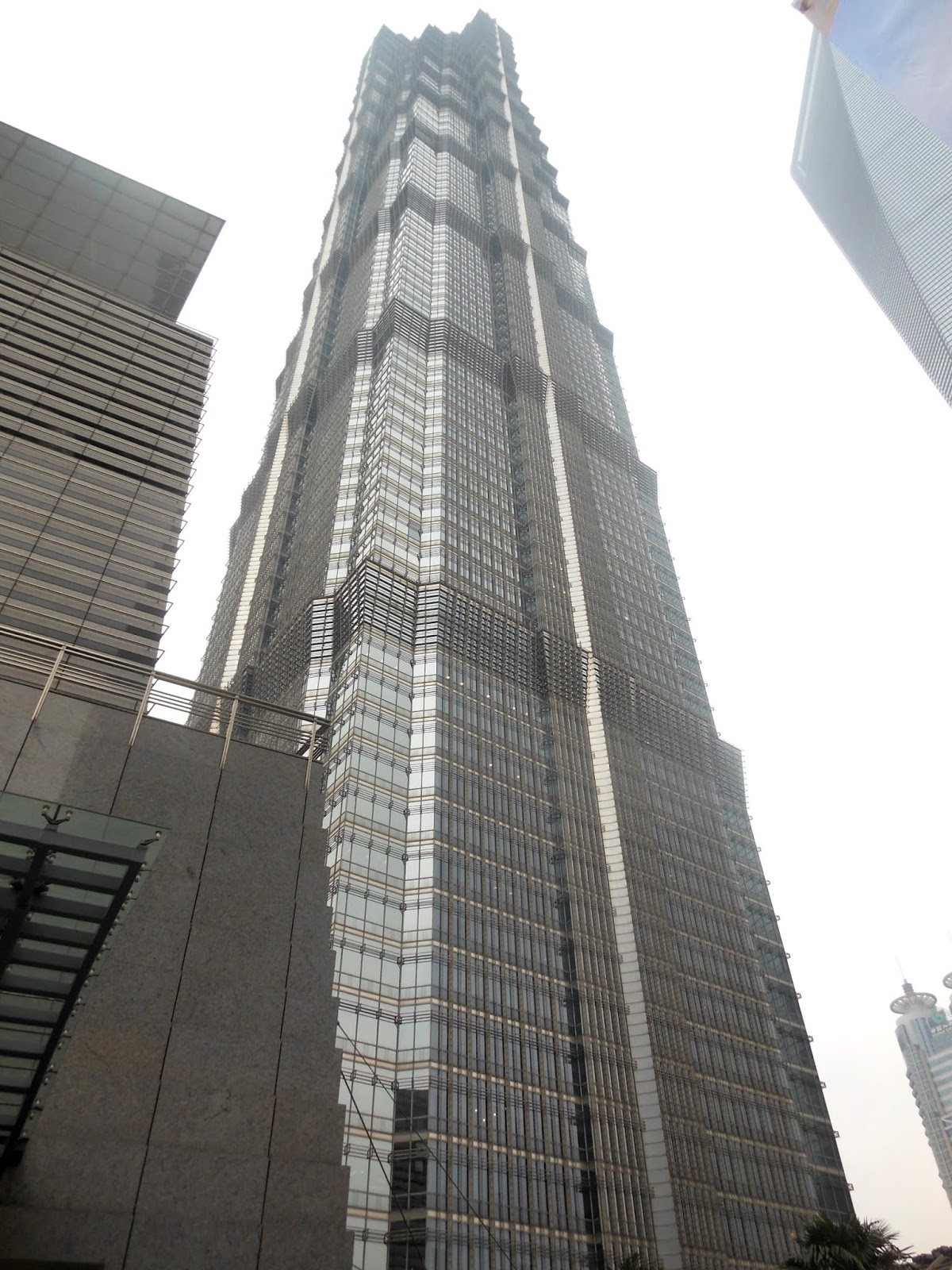
The Jin Mao Tower is 421 meters tall (1380 feet) (Empire State Building is 1454 ft). It contains a shopping mall, offices and the Grand Hyatt Hotel (at the time of completion it was the highest hotel in the world). It was the tallest building in China from its completion in 1999 until 2007, when it was surpassed by the nearby World Financial Center. The Shanghai Tower, a 128-story building located next to these two, surpassed the height of both in 2015, creating the world's first trio of adjacent supertall skyscrapers.
 A highlight of visiting the tower was getting to watch these cute school children. Just as we were given time to use the restrooms before ascending up the elevator, these children also were using the same restrooms. They were just so charged and happy, and their teachers were herding them to and fro, and into these lines. Later, in the tower observation areas, they were just having so much fun.

Janet's comment: Waiting in a long line to use the restroom, I said hello to a couple of these adorables! They quickly responded back on cue, “Good morning.” Thought I would move forward with their knowledge of the English language and said, “How are you?” Melted my heart to hear them recite in unison, “ I am fine, thank you!” They loved being able to respond and sang a song for me, showing me words for ears, mouth, eyes and nose. I also got a chance to visit with their teacher. How I loved her joyous teacher-passion for these children. So many similarities in connecting to others that live so far away and in different living conditions. Heart to heart, isn’t that what life is for?
It was a hazy morning, so the views were limited in distance. You see again the Pearl Eye communications tower, also shown in the top photo in this posting. The river is the Huangpu River, which flows a few miles north to empty into the famous Yangtze River just as it reaches the ocean. The top end of the Bund is on the far side of the river.
This map shows where we visited on this day. In the center, where the river bends, are the Pearl Eye Tower, and just to its right, the Jin Mao Tower. I have photos below of the skyscraper next to it, with the "window" near the top of its 118 stories, the World Finance Center. Across on the west side of the river is the Bund and the old city. A little to the south of the old city are two of the shopping areas we visited later in the so-called French Concession. We then bused way off this map, to the east and south, to the airport, and took the Maglev train back to the bottom right corner on the map (see where it says Maglev Train?). We then went a short distance up near the green Century Park to the Knock Off Market. Finally, our night cruise boarded just above the Pearl Eye Tower and went south, and then we turned around and returned.
This view from the Jin Mao Tower shows the bottom end of the Bund and the old city. 
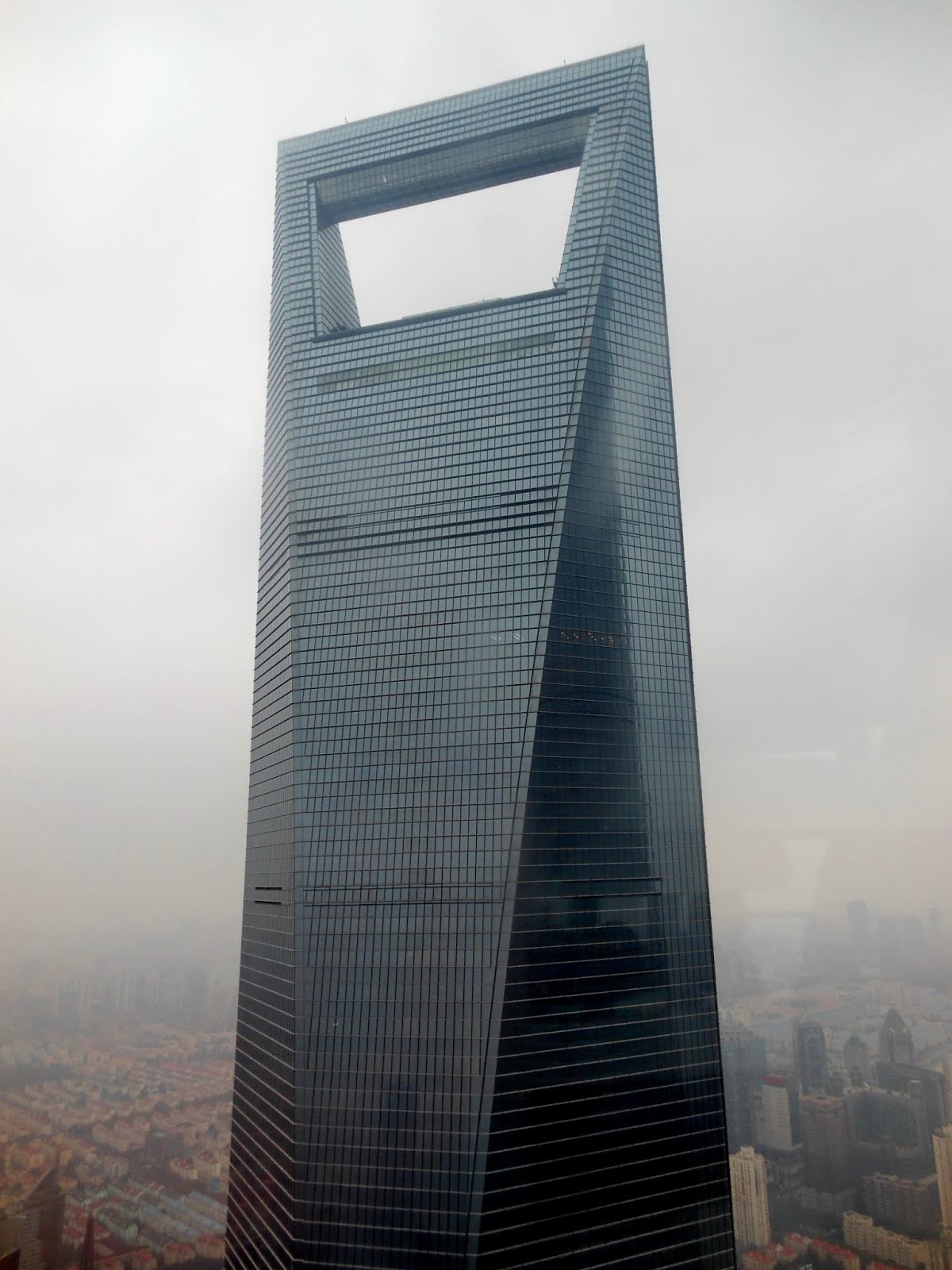
The Shanghai World Finance Center next to us, 234 feet higher than where we were. 
The other nearby skyscraper was the Shanghai Tower, the tallest of the three at 128 stories, and 693 feet higher than where we were. I thought it was interesting that the entire outside of the building was glass, and you could see right through its sides.
Here's a picture in the observation room with all those kidlings being rounded up by their teachers. 
There was a wall display about the Spaniard who set the record for climbing the 2008 steps of the tower (in the year 2008!) on his mountain bike. Took him 39 minutes, 38 seconds.
The display also showed the record progression, starting 2006, when it took 1 hour 41 minutes. Wow, the big drop in time happened when the Chinese guy did it in 48 minutes, from the previous record of 93 minutes. I'm sure I could not jump even a single step on my bike. 
This is a strange photo, but it's looking down from the center of the observation floor, into the Grand Hyatt Hotel below. The 548-room hotel occupies the 53rd to 87th floor, so the landing at the bottom is the 53rd floor. 
From the skyscrapers on the eastern financial side of the river, we crossed over to the old city and went a bit south to an area called Tianzifang, a touristic arts and crafts enclave that has developed from a renovated traditional residential area in the French Concession. It's now home to over 200 boutique shops, bars and restaurants. Look at all those overhead wires; it reminded us of Bangkok.
We are not really shoppers, but it was interesting walking around this area because we were looking to buy "stocks" for each grandchild. (Jeanette and Mike had gotten some previously, and after seeing them, we thought they would be special gifts. They are marble stamps with the child's name in both English and Chinese, including their zodiac animal.)
In 1849, the French were given this area as a gesture for trade relations.They were like little foreign enclaves within the city. Chinese were originally forbidden from entering, but they later were allowed in. It remained under French control clear up until 1943.
So many cute little joints, like this one with a wine cask on each table!
With only about 25 minutes to go in our hour to roam, we found this little vendor who sold stocks. You can see they are little square columns, and the zodiac animal is carved into the side of them. On one end is where she will carve/etch the names. We negotiated a price for six of them, and the process began!
We told her the birth years for Morgan, Rylee, Tyson, Liam, Lexie, and great-niece Sophia. We slowly pronounced each name as she wrote down the Chinese characters that would sound like those names. This photo shows her getting ready for the carving by writing the characters for each name. I made this photo large so you can see "Monkey Lexie", then "Rabbit Tyson and Sophia", then "Pig Morgan" and Dog Rylee." The top name for "Horse Liam" is hard to see at the top of her listing.
She set about carving the ends of the marble stamps. Of course, she had to carve them in a mirror image so that when stamped onto something, the letters would read correctly.

You can see one of the stocks in her right hand, and all the others on her top shelf. The white powder is the marble shavings from the carvings, and she's getting ready to throw it into the trash. The stocks came out great!
In this picture, she is applying some red ink to her finished carving to test it on a small piece of paper. They came out perfectly. When we got home, we bought six red ink pads and gave the kids their souvenir stocks for Christmas. They were a big hit!
By the time we paid and got back to the meeting place, we were a few minutes past our allowed hour, but others were even later so it was not a problem. We then drove less than a mile farther south to another renovated enclave from the French Concession called Xintiandi. This area had been completely torn down and rebuilt to be a trendy restaurant area. We were let loose in this square to find lunch. Janet and I found a nice Italian place and enjoyed our novel pizza and other unique dishes.

Shanghai was originally a fishing village and market town, but grew in the 19th century due to its perfect protection up the river from the ocean. It became one of five "treaty ports" forced open to foreign trade after the First Opium War. In 1949 under the new People's Republic of China's Chairman Mao, trade was limited to other socialist countries, and the city's global influence declined. But in the 1990s, economic reforms resulted in an intense redevelopment of the city, especially the Pudong financial district, aiding the return of foreign investment to the city. The city has since re-emerged as a hub for international trade and finance; Shanghai has been described as the showpiece of the booming Chinese economy. 
After lunch, when we got back late and Steve had to call me to ask where we were (oops), we took the long bus ride out to the airport. There, we went to the adjacent train station to ride the world's fastest passenger train, the Maglev (which stands for Magnetic Levitation).
There's the train, with Sumi posing. The line is the third commercially operated maglev line, following a British and a German one, but both were low-speed operations and closed before the opening of the Shanghai train. This is the fastest electric train in the world with a cruising speed of 431 km/h (267 mph).
 It wasn't too crowded at 3 pm on a Monday. We're getting ready to take off. This train run is very short, actually, traveling only 19 miles into the city. By the time it reaches full speed, it has only about a minute before it must start slowing down.
The monitor over head was fun to watch. We departed exactly at 15:00 (3 pm), so in one second it had gotten up to 9 km/h. Not yet impressive, but wait!
64 mph in 32 seconds...
141 mph in 85 seconds...
261 mph in less than 3 minutes. It reached its top speed of 267 mph (431 km/h) six seconds later, but my photo of the monitor came out blurred. Janet was next to the window and got some photos of the scenery whizzing by, so maybe I can get a few of those and add them later. The speed remained at its max only for a minute or two before it had to start slowing down. Remember, our trip was just 19 miles, and it took only 8 minutes! 
Here's the track for the maglev train. The "levitation" it achieves allows for no contact and therefore no friction. From Wikipedia: "It uses two sets of magnets, one set to repel and push the train up off the track, and another set to move the elevated train ahead, taking advantage of the lack of friction ...there are no moving parts. The train travels along a guideway of magnets which control the train's stability and speed. Maglev trains are therefore quieter and smoother than conventional trains, and have the potential for much higher speeds...and can accelerate and decelerate much faster than conventional trains; the only practical limitation is the safety and comfort of the passengers."

I have no more photos until our river cruise a few hours later. When we departed the train, we went only a short distance north to the so-called Knock Off Market, and were given two hours "to shop". Sigh... It was actually named A.P. Xinyang Fashion and Gifts Market, and was all indoors, underneath the Science and Technology Museum. It was massive and crowded, with 100s of vendor stalls. 
Actually, Janet did bargain and purchase this pretty lantern, seen here hanging in our home. But we saw as much as we cared to in about 40 minutes, and then had to wait the additional 80 minutes until Steve would be back to get us. Many of us felt the same, because we all gathered, talked, and grumbled a bit about this "all-day optional tour" that dumped us here for two hours. Some of us, including me, sat on the floor, and I actually took a little nap.

When Steve finally arrived, we took our bus back across the river and up to our boat dock. Our next optional excursion was what turned out to be a highlight for us in China, at least from a visual standpoint. But getting onto the boat was a "cultural experience" in itself. Steve later tired to explain that the pushing and shoving to get to the front of the line was common among the less-educated Chinese. But wow, it was hard to take, and I actually physically shoved one guy right back to behind me after he had pushed past me. Janet laughs to this day about how shocked everyone was behind us who witnessed that. 
We eventually all got onboard, and the boat headed south with a spectacular light show on both sides of the river. On the lower decks where we began, it was extremely crowded. But pretty soon, Steve negotiated with the staff and we got to go to the top deck, which gave us (cold and windy) uncluttered views and photo ops. Behind Janet is again the Pearl Eye, plus the three tall skyscrapers we had seen in the morning from the top of Jin Mao (seen a bit to the left of the Pearl Eye, with a golden pointy top). 
On the other bank of the river was the Bund, with these older government buildings plus some new fancy high rises behind. Janet and I (and the five others) had missed visiting the Bund on the first day, but here's a little about it: From the 1860s to the 1930s, this was the main port area when Shanghai was a "treaty port", a rich and powerful foreign establishment (with the French Concession as well as German, English, and USA Concessions). The Bund has dozens of historic buildings along the Bund, including banks, trading houses, consulates, and "clubs", e.g., a Masonic Lodge.
This photo is from when we first departed the dock, taken on the west side of the river, but we had not yet gone far enough to have reached the Bund. 
 Another shot of the Bund, but from much farther downriver. 
Here again we see the three super skyscrapers in the financial district. The Shanghai Tower is the tallest, to its left is the World Financial Center, and partially blocking that is the Jin Mao Tower. 
The entire cruise was an amazing display that China created to show off their economy and status in the world, and it worked. This was near the end of the cruise, with the Bund behind me on the left, and north of the Bund on the right. 

When it was time to depart the boat, there again was a massive crowd push, only this time, it turned out we were standing right where they opened the gate to exit. Thus, I held onto the rails and used my body to push the hoard back while those of us who just happened to be in that spot could exit calmly without getting stampeded. Hee hee (Even though I'm only 5'8" and skinny, I was bigger than the "locals" doing the pushing.)

On the ride back to our hotel, Steve had the bus wait while several of us went into a McDonald's to buy dinner (rather than eating at the hotel restaurant again). That's what Janet and I ate, and it was kind of a relief to have familiar burgers. At the hotel, we packed for our flights the next morning. What a day, and what a week in China! We did not venture far into that vast country, but we nevertheless experienced much of their culture and history, and many fascinating sights. Yes, their economy is booming, but it remains an authoritarian dictatorship which limits freedoms and cracks down hard on expressions of dissent. "Great to visit, but we wouldn't want to live there" (whereas when we visited places like New Zealand and Australia a year ago...).

On to Japan!


Thursday, January 16, 2020

Lake cruise, tea garden, and pagoda

Day 6  Sunday, November 17, 2019   Hangzhou to Shanghai

Our morning excursion was to West Lake, in Hangzhou . We had a short cruise here, then we went to a nearby tea plantation (sales time!), followed by a visit to Liuhe Pagoda, and finally took the long bus ride back to Shanghai.
We had another local guide in Hangzhou, Aaron, who gave us some history during the bus ride to West Lake.

The city has an 8000-yr history, and has been one of the most renowned and prosperous cities in China for much of the last millennium. About 3000 BC they "invented" rice here. In 1275, when Marco Polo visited, it was the largest city in the world. (Although Marco Polo is said to have discovered pizza and pasta here, Aaron said that was not actually correct.)

Hangzhou was the southern end of the Grand Canal, which extends to Beijing. Because the Qiantang River flows only about 12 miles east before reaching the ocean, it meant the Grand Canal connected to the sea. Hangzhou is the headquarters for Ali Baba, the "Amazon" of China. Nine million people live in the city.
We boarded our cruise boat. There's Aaron, our local guide. One of his stories was the legend of the  Butterfly Lovers, the "Chinese Romeo and Juliet". It was, of course, a tragic love story, dating from about 200 AD.
Two wooden boats during our cruise. West Lake is divided into five sections separated by three causeways. There are numerous temples, pagodas, and gardens, and artificial islands within the lake. It has influenced poets and painters for 1000s of years, for its natural beauty and historic relics. West Lake has been among the most important sources of inspiration for Chinese garden designers. It was made a UNESCO World Heritage Site in 2011, described as having "influenced garden design...reflecting an idealized fusion between humans and nature."
What a unique boat! I found it interesting to learn that over 2,000 years ago, West Lake was still a part of the Qiantang River. Due to soil sedimentation and runoff from the surrounding mountains, shoals formed to create a bank, and the lake formed to the west of the river. In 1089, a renowned poet Su Shi, the city's governor, used 200,000 workers to construct a 1.7-mi-long causeway across West Lake. The Su Causeway is still there.

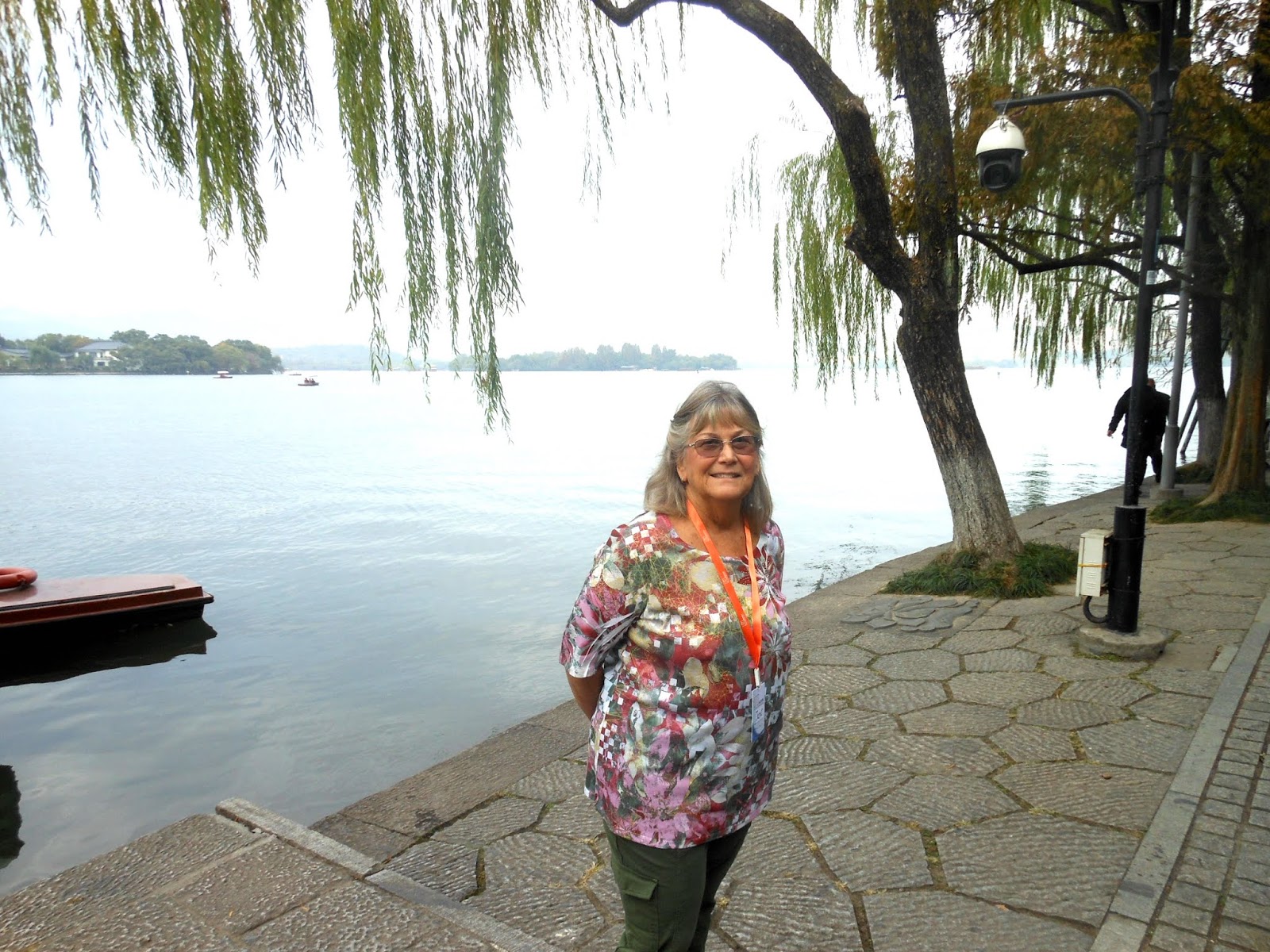
One more photo from West Lake. 

I stole this photo from the Internet since mine did not come out. We cruised past these three "stone pagodas", which are on the one Yuan bill (I pulled one of the bills out of my wallet and we passed it around to see this scene we passed). The stone pagodas were originally built in 1089 during the Song Dynasty (960- 1279), standing in a triangle on three deep-water pools. They lie near the man-made island known as Three Pools Mirroring the Moon, a West Lake landmark and the symbol of Hangzhou.

The island got its name from a Chinese Mid-Autumn Festival (Moon Cake Day), when candles are lit inside the round holes of each pagoda, creating the mixed splendor of candle light, moonlight and lake light on the three-pool area in the lake (hence the name of Three Pools Mirroring the Moon).

Aaron told us about the world's largest tidal bore, on the Qiantang River between Hangzhou and the ocean bay, about 12 miles to the east. The tide rushing into the river mouth from the bay causes a wave which can reach up to 30 ft in height, and travel up to 40 km/hr (25 mph)! In 2007, a group of international surfers made several attempts to surf the tidal wave, and a French and a Brazilian rode one wave continuously for 17 km (10.5 miles), lasting 1 hour and 10 minutes. This was hard for me to imagine - 30 ft high at 25 mph, so I found several You Tube videos to watch it. Wow.
Not far from Hangzhou, we visited the Longjing Tea Plantation near the village of Meijiawu. It is famous for Dragon Well tea, which they said was more than just a national beverage; like the pearls in Wuxi, it is a medicine (cures cancer!), a way of life, an opportunity to get in touch with your spirituality, and a way to make money from tourists! haha
The setting was indeed scenic. Aaron explained how tea is grown and harvested, and how, of all methods used in the world for tea, the ways they do it here are clearly the best. Their tea has the highest levels of healthy polyphenols, etc. Next, of course, we went inside for a demonstration, tasting, and sales pitch. If you didn't want to drink the tea for its health benefits, you could take supplements made from it. Janet originally asked to buy their high-dose supplement (just one tablet per day instead of four), but when she heard the $200+ cost in US dollars, she said "no thanks."
Here are Janet and "the boys" hanging around, waiting for those still at the presentation to make their purchases.
Our final stop in Hangzhou was the Liuhe Pagoda, the best preserved wood-and-brick pagoda in China. It is on the north shore of the Qiantang River, and was originally constructed in 970, destroyed in 1121, and reconstructed fully by 1165.

Liuhe means "six harmonies", and the reasons for building the pagoda were to "calm the tidal bore" of the river, and as a navigational aid. This photo is from our walk around the grounds behind the pagoda. It was called Ringing of the Liuhe Bell.

This area behind the pagoda was called the Liuhe Allusions, with these eclectic statues.
Being of considerable size (60 meters - 197 ft tall) and stature, it actually served as a permanent lighthouse from nearly its beginning, to aid sailors in seeking anchorages at night.
You can see how close it was to the Qiantang River, with the financial center in the background on the south side.

Before we departed on the long bus ride to Shanghai, we bought some snacks as a lunch at the pagoda's parking area. We bought some warm, spiced potatoes, and I forget what else.

The 100-mile bus trip to Shanghai took a few hours. Our hotel was the same one the others had stayed at on the first night, while seven of us were held over in Beijing. There weren't any restaurants in the area, so we ate at the hotel restaurant. There was a language problem, but we finally communicated that we wanted wine, and I got the entree I ordered. Janet never did, but she gave up and ate some of mine. Our bill had her entree charge on there, and when I went up to point it out, they asked if she still would like it. "No, not anymore." So, three of them debated in rapid Chinese for a couple minutes, and finally they gave me a corrected bill.


Thursday, January 9, 2020

Giant Buddha and Pearls

Day 5  Saturday, November 16, 2019  Wuxi and on to Hangzhou

Grand Buddha, built in 1997, is 88 meters (289 feet) tall, since 88 is a lucky number in China. Why? Because the word 8 sounds similar to the word fā, which implies wealth. Also, the shape of the Chinese character for 8 () implies that a person will have a great, wide future because the character gets wider toward the bottom. (The Chinese government has been auctioning auto license plates containing many 8s for tens of thousands of dollars. And, the Beijing Olympics opened on 8/8/08 at 8 p.m!)

We had another breakfast with a vast array of items from the buffet, some quite odd from our Western cuisine. Every previous breakfast had had a juice option, but not this morning, although they did offer cola from the glass juice dispenser!
Our first stop of the day was the Pearl "Museum", but it was really just a fancy term for their tourist shop for buying pearl jewelry and pearl health supplements. In the entry they had these oysters in water.

I must mention that on the bus drive to the pearl place, our local guide, Vivian, talked non-stop about the holistic health approach she recommends, about how Wuxi citizens believe in natural, and vegan, and how healthy pearls are. She, and later the guides at the "museum", made it sound as if pearls can cure everything. According to Vivian and our guide, pearl powder strengthens skeletal tissue and function, especially bone, and helps cardiovascular functions. Pearl apparently cures constipation and increases endurance. And she made an emphatic point, pointing to her own pretty face, that pearl is one of the great secrets of the most beautiful women in Asia.
Before the sales force descended on us in their jewelry display, they gave a presentation about pearl cultivation. They've been harvesting pearls here for 2000 years. The oysters grow well in the adjacent Lake Taihu. My photo is blurry, but she has just sliced open a large, 4-yr-old oyster and she's picking out the many pearls inside. There are three so far sitting there, but she ended up pulling out 28 of them. They gave one to each of us (somehow, Janet and I lost ours. Oh no!).

I have no more photos from here, but it was crazy-sales-pitch time on the display floor. The sales ladies would follow you around and if you showed even the slightest interest in anything, they'd swoop in and give you a sales pitch about it. We did not purchase anything. I don't know whether anyone in our group did either.
Then it was off to the Grand Buddha, at the Lingshan Buddhist Scenic Spot. In this photo, you can get a glimpse of Vivian behind Janet's head. You also can see the "Ascending Cloud Avenue" leading up to the statue, with 216 stairs standing for 108 troubles and 108 wishes. The stairs are set on seven rising platforms (why not eight, I wonder?).
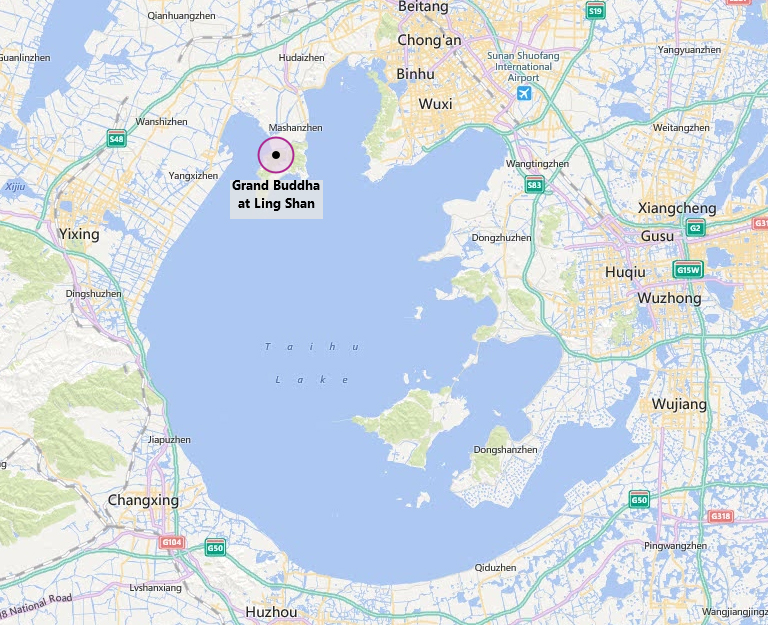
Lingshan is located at the base of a peninsula jutting south into Lake Taihu, just west of Wuxi. It is actually a lot more than just the Grand Buddha, more like what I called "the Buddhist Disneyland." It was 74 acres, and developed only 20 years ago, when China began allowing religion again following the Cultural Revolution.
There were all sorts of sites to see there. Our group took two trams, one from the entrance gate to Ancient Ginkgo Square (where there was a 1400-yr-old ginkgo tree), and then another tram up to the Grand Buddha statue. Thus, we saw several of the sites only from our passing tram, but we did visit in depth the Xianhu Temple and the Brahma Palace, plus we ate lunch at the Vegetarian Restaurant.
The Grand Buddha had a swastika on his chest, which Westerners typically find interesting based on the Nazi symbol (which was right-facing, whereas this symbol is left-facing). The swastika has long been a religious icon in Eurasia, used as a symbol of divinity and spirituality. It has different specific meanings depending on the religion, but in Buddhism, it symbolizes "the auspicious footprints of the Buddha".
 We took a tram to the bottom of the Grand Buddha, and here, people were praying and looking steeply upward to the massive statue.
There at the statue's base, you could buy candles and other prayer pieces. Many Buddhists were there and actively taking part.
One more photo of those giving prayer in front of Grand Buddha. You could pay extra to climb stairs up to a lookout point in the statue, but Vivian warned our group that it would likely take too much time based on our next assembly time back down in Ancient Ginkgo Square.
To meet up again with our group, we had to descend this long staircase! You can sort of see the 1400-yr-old ginkgo tree at the base down there, with the Xiangfu Temple right behind it.
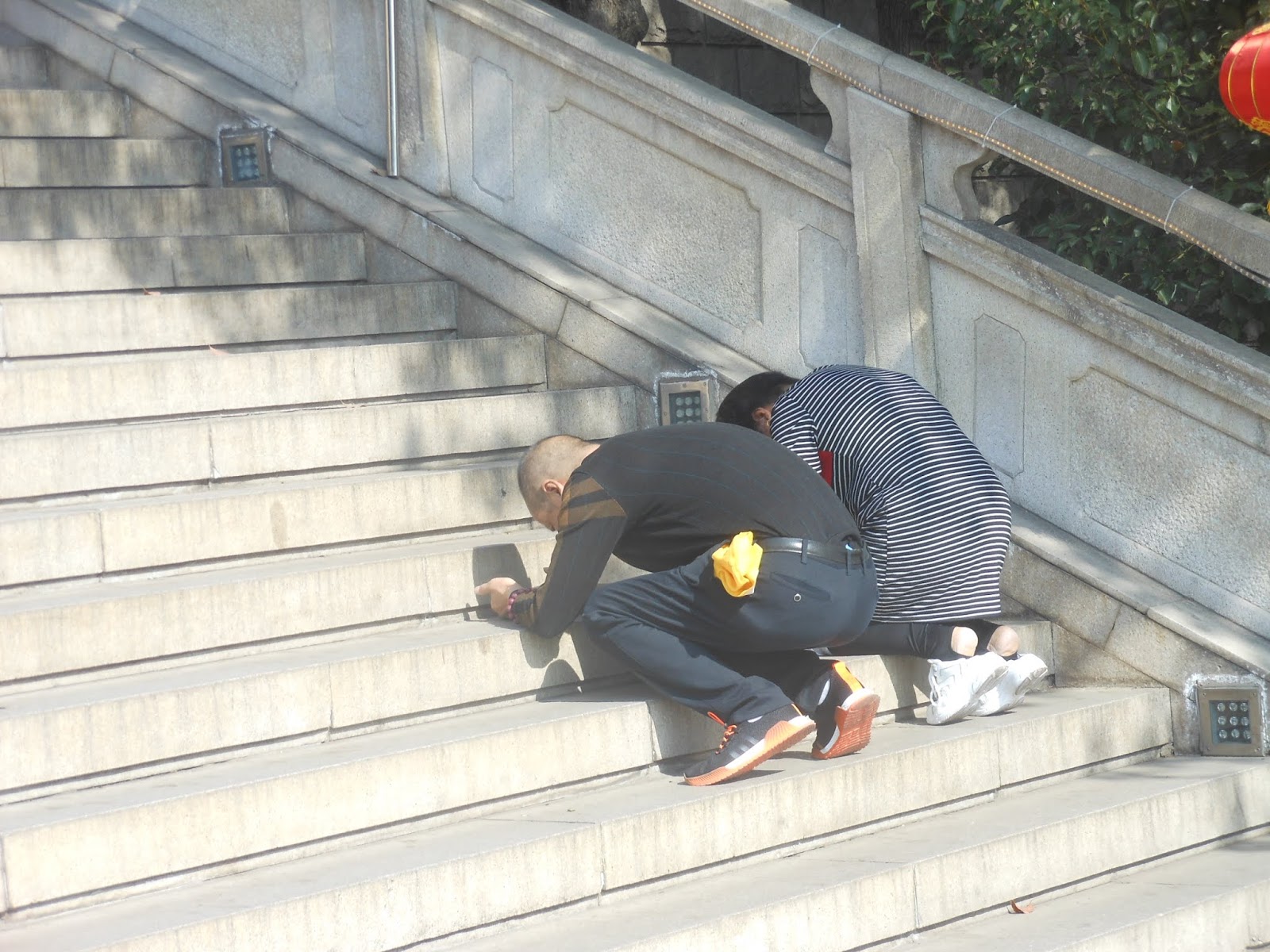
As we descended the steps, we saw many Buddhists ascending two steps at a time, and kneeling to pray after each stride ahead. That would have taken them a LONG time to reach the top, since there were 216 steps.
Here's another photo of one kneeling to pray every few feet on the way up.
Still others were praying as they ascended, but they did not kneel down every few feet along the way.
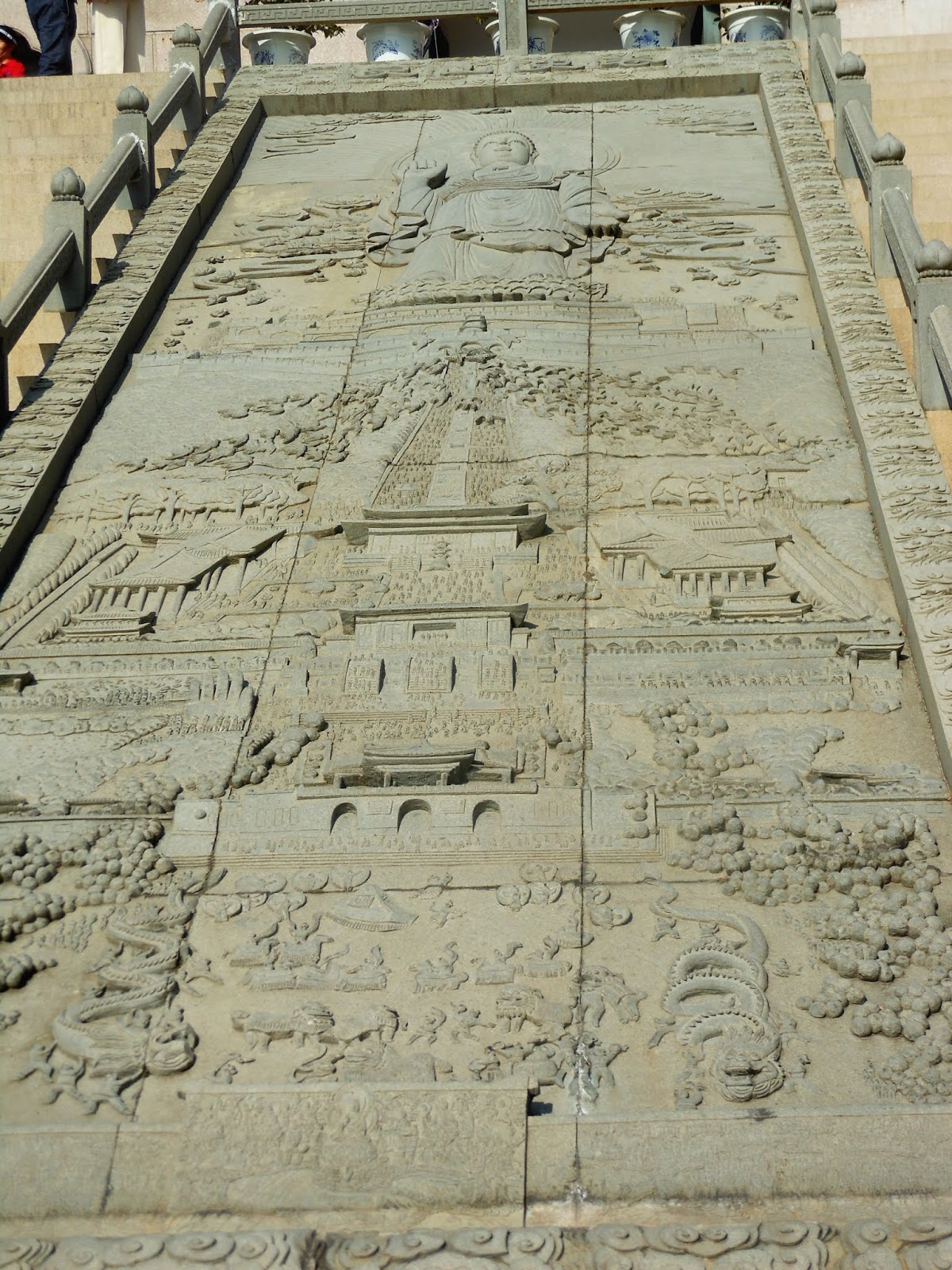
Down the center of the long stair-steps were intricately carved sculptures. This is the only one I photoed, and it's a "map" of the entire "Buddhist Disneyland".
There's the NEW Janet and the OLD ginkgo tree. That tree was planted when the adjacent Xiangfu Temple was built, 1400 years ago during the Tang Dynasty. It continues to bear ginkgoes every autumn.
What a colorful roof line on the Xiangfu Temple. When the Lingshan Buddhist Scenic Spot was created in 1997, this temple was its historic base since it was originally built here in the 7th Century. It had to be restored following the Cultural Revolution.
The large golden Buddha inside the temple, with numerous visitors offering prayers. Note all the floral arrangements, presumably added frequently.
More intricate carvings inside the temple.
Our next stop there was the vast Brahma Palace, to showcase Buddhist culture, traditional Chinese art, and host events and gatherings. It had a symmetrical layout, and was built of stone with grand halls, high porch pillars, wide girders and towering domes. CNN named it one of the 40 most beautiful sights in China. It took two years to build, opening in 2008 for the 3rd World Buddhist Forum.
The main hall was very spectacular, and three stories high. We had to remove and carry our shoes once inside. Around the outer walls were 12 huge oil paintings, 9 feet wide and 21 feet tall, depicting the 2000-yr history of Buddhism - its origin, spread, communication and development.
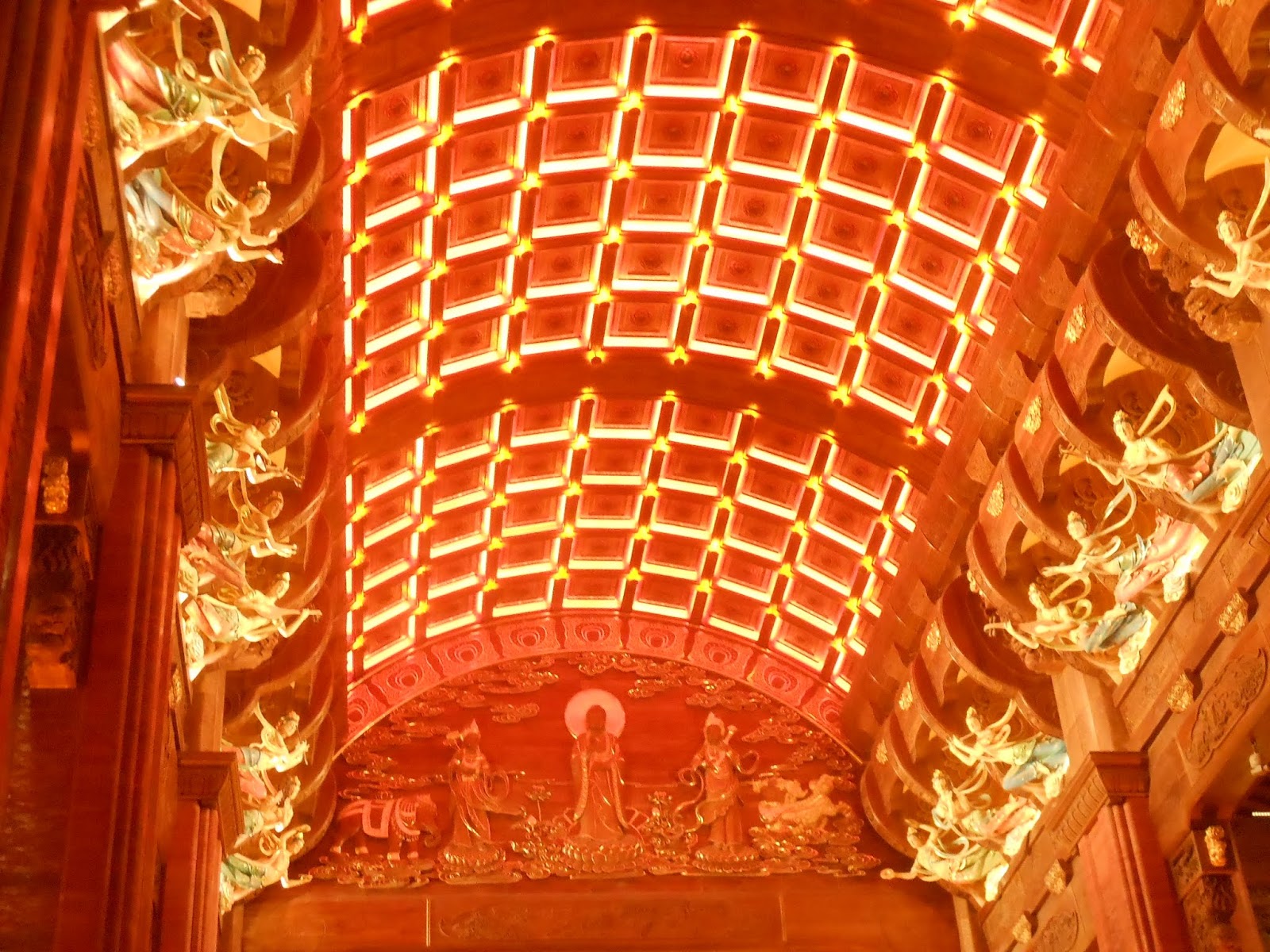
The ceiling was pretty fancy! You can see the golden Feitian, or sky gods, on both sides.
This dome, called Tower Hall, is the palace highlight, right in the center of the palace. It's over 180 feet to the top.
At the far end of the main room was Alter Hall, containing this giant oil painting portraying flying angels around a sitting Golden Buddha statue. They used more than 10 kg (22 lbs) of pure gold as its core component.
 This was my final photo at "Disneyland". After visiting the palace, we ate lunch at a huge cafeteria. Steve had to help us order food. Our table had more "tame" foods than those at the table next to us, where they ordered a wide variety of items to try. On our way out, I got a shot of this rock garden with waterfalls, to welcome visitors, with the Grand Buddha way off in the distance.

I do not have any other photos for the day. It was a long drive south to Hangzhou ("hung-joe"), and Steve talked about all kinds of topics. Here are some things I wrote down:

1) Population issues: Avg age in the 70s was 55, and now it's 76 for men and 78 for women (Steve said longer life was partly due to their diets now having more fruits and vegetables). The one-child policy, initiated in 1980, means that now there are far too few younger people supporting the aging population.
2) As of 2016, China allowed parents to bear two children instead of only one, but it's not taking hold. At this time, birth rate is at its lowest in 60 yrs (14.6 million babies born in 2019 is low?), continuing to put pressure on the country's under-funded pensions and overcrowded hospitals.
3) The low birth rate is due to a) the rise of women in the workplace, who don't see marriage as necessary for financial security; 2) the lopsided population of men vs women (30 million single men out there!), because during the one-child rule, males were favored and therefore female fetuses were aborted; 3) couples cannot afford children due to rising costs and jobs demanding more time and energy; and 4) attitudes toward having children have simply changed.
4) In the 90s, China had its "Big Leap Forward", becoming more industrialized and moving away from small-family farming. (It meant to me: The country became authoritarian capitalistism and they gave up communism.)
5) Prior to the Big Leap Forward, China lied and tried to show off its communism, and in the early 60s, they suffered a widespread famine and millions died of starvation.

6) 400 million farmers have moved to the cities during the past 30 yrs. Farming has become "agri-business", with 100s of miles of greenhouses in the northern provinces, fish farms (fed silkworm poop!), and vast tomato and chili farms in the west. And, with genetically improved "super rice" strains, China is a food exporter for the first time.
7) Nov 11 every year is "Online Shopping Day", when 200 billion Yuan are spent. Because today was Nov 16, just five days since Online Shopping Day, Steve said that one billion items were in process of being shipped all over the country and world.
8) China has 26 provinces. Beijing is the northern capital, while Nanjing (a bit to our northwest) is the southern capital.  On our trip, we started in Shanghai Province (yes, it has its own), then Jiangshu, and today we headed south into Zhejiang (once we were south of Lake Taihu). They have 56 nationalities among their citizens.
9) China's capital 900 yrs ago was where we're headed tonight - Hangzhou. Where the famous Terra Cotta Warriors are, Xi'an, was the capital city for 13 dynasties, from the 11th Century BC to 770 BC.

10) They have four national languages: regular Chinese (which has many dialects), Manchurian, Uyghan, and Tibetan). Uyghurs is in the far west, and its people are Muslim. (There are numerous reports of religious intolerance and injustices against the Uyghurs, just as the Tibetans are discriminated against because they want their independence.)
11) The Cultural Revolution, 1966 to 1976, destroyed four things: royalty, religion, private business, and "smart people" (scientists and engineers). If you represented any of these four areas, you would be, or could be, put in prison.
12) The Marriage Market. In Shanghai, parents are advertising their daughters for marriage! There are so few women that when a family did keep a girl baby, they grew up having the best of everything. Consequently, these young women now have high expectations for a husband.
13) Fake divorces. I forget now how the details went, but Steve described how some couples get divorces so that they can qualify for better properties as singles than as married. But, the couple actually stays together and remarries once their windfall is achieved.

I do not recall anything that evening when we arrived at our hotel. It was an airport Holiday Inn, and I think we walked to a nearby restaurant.